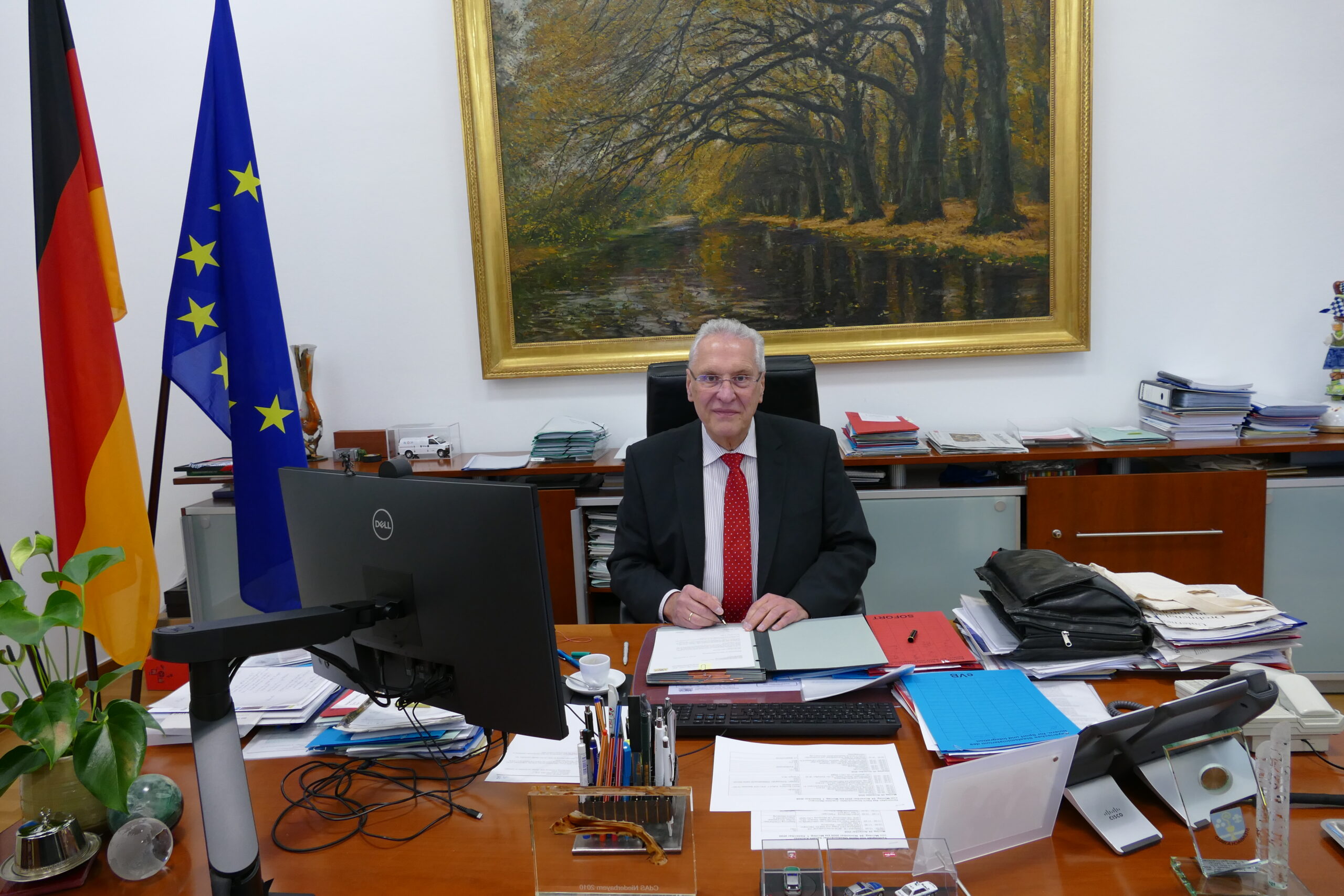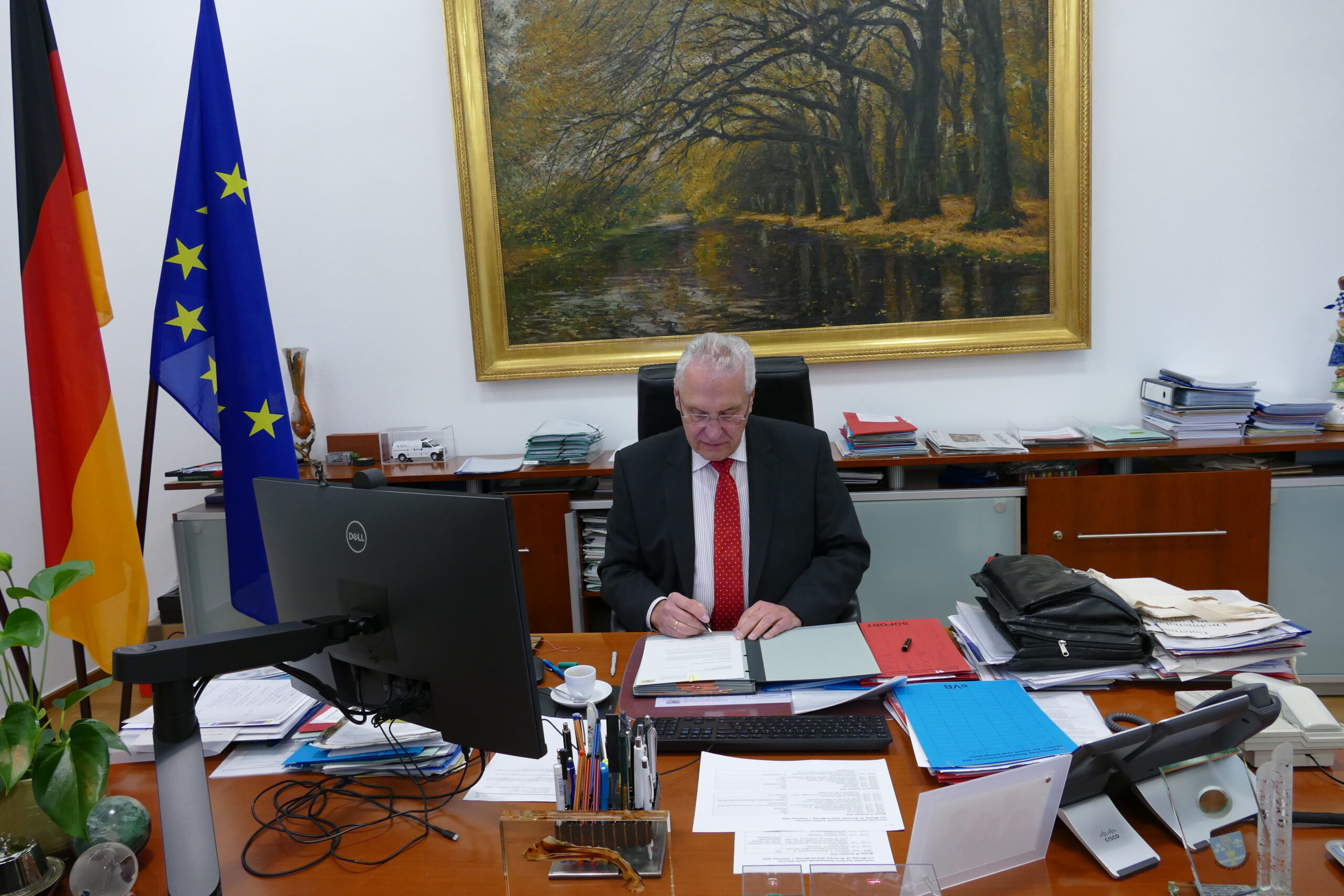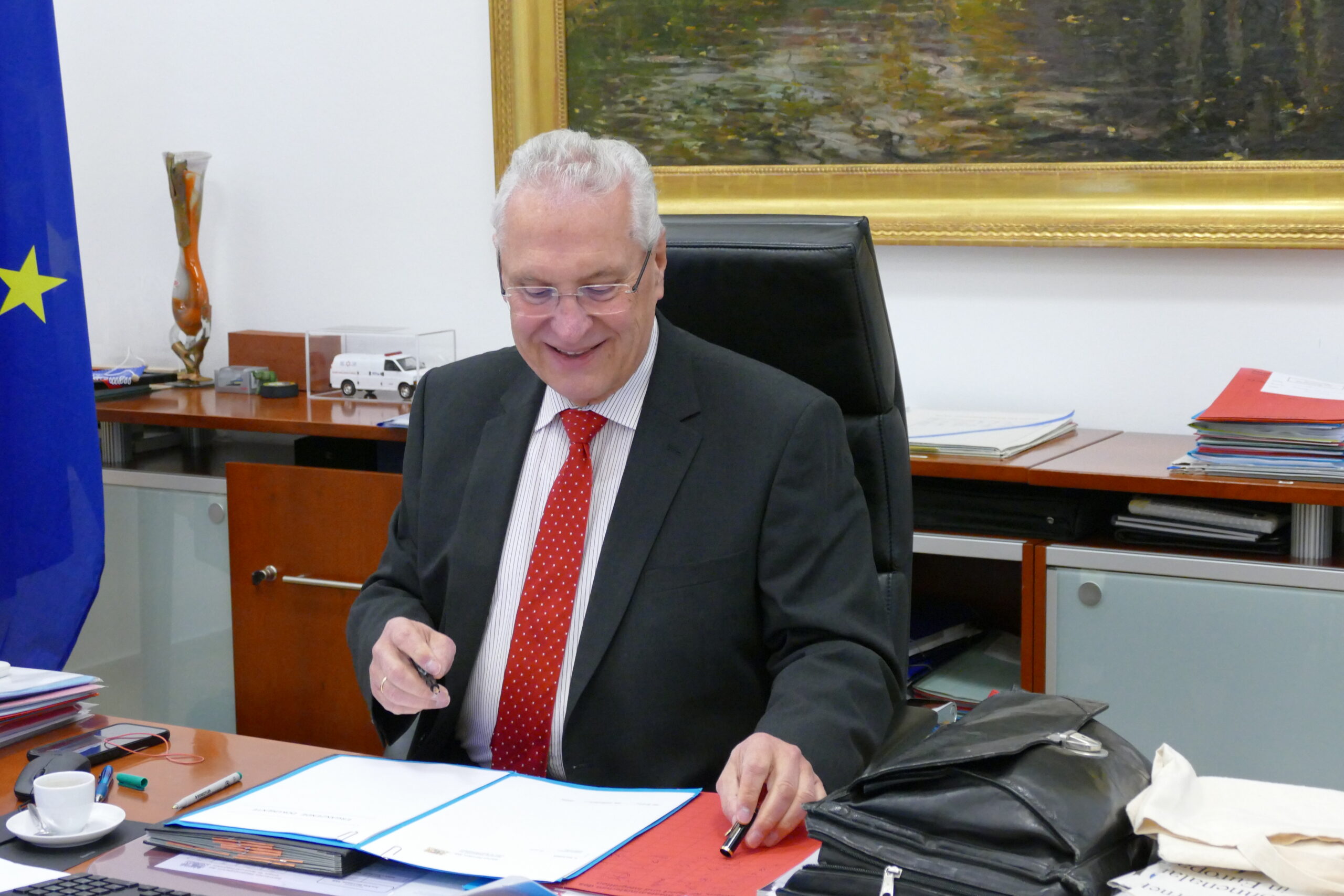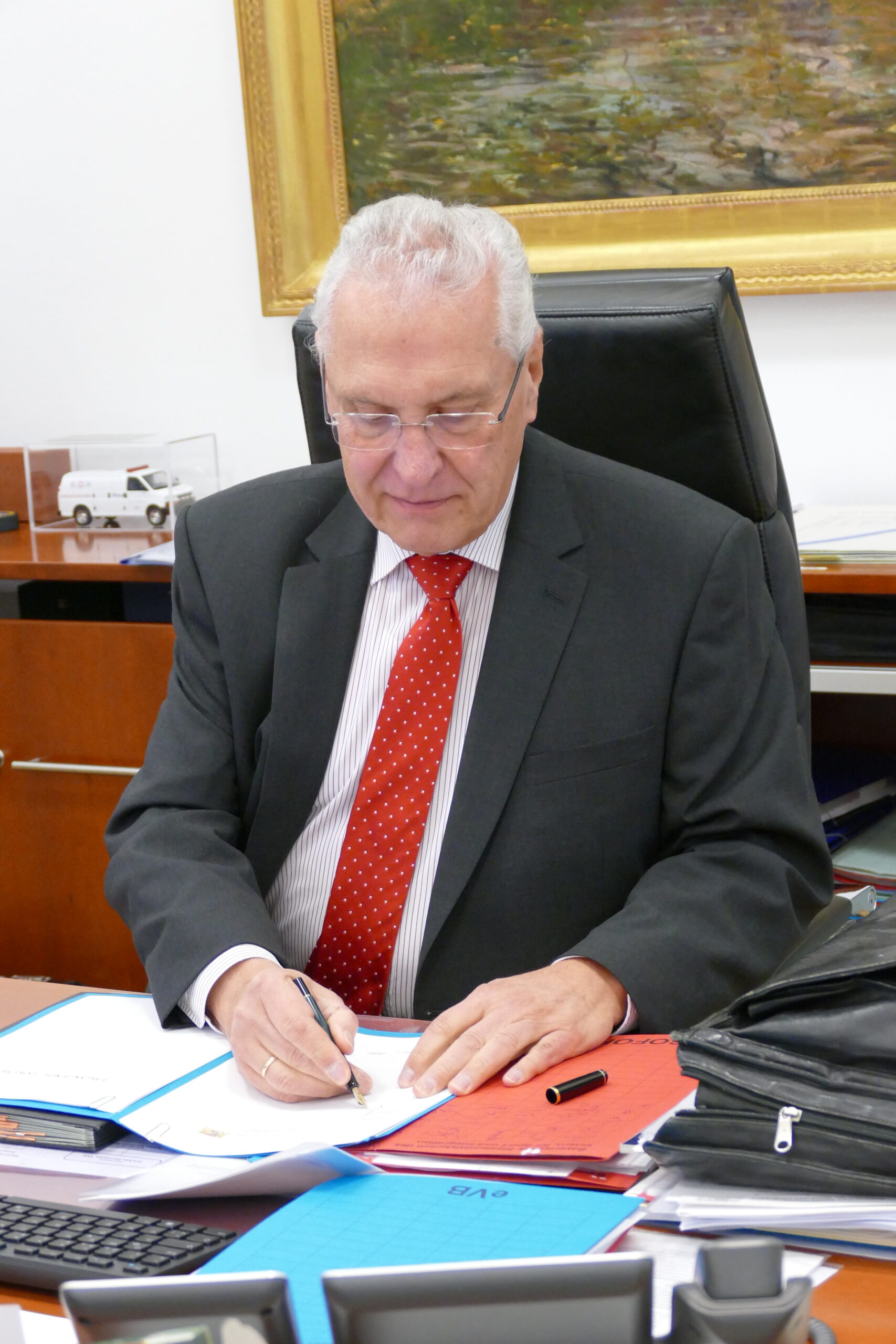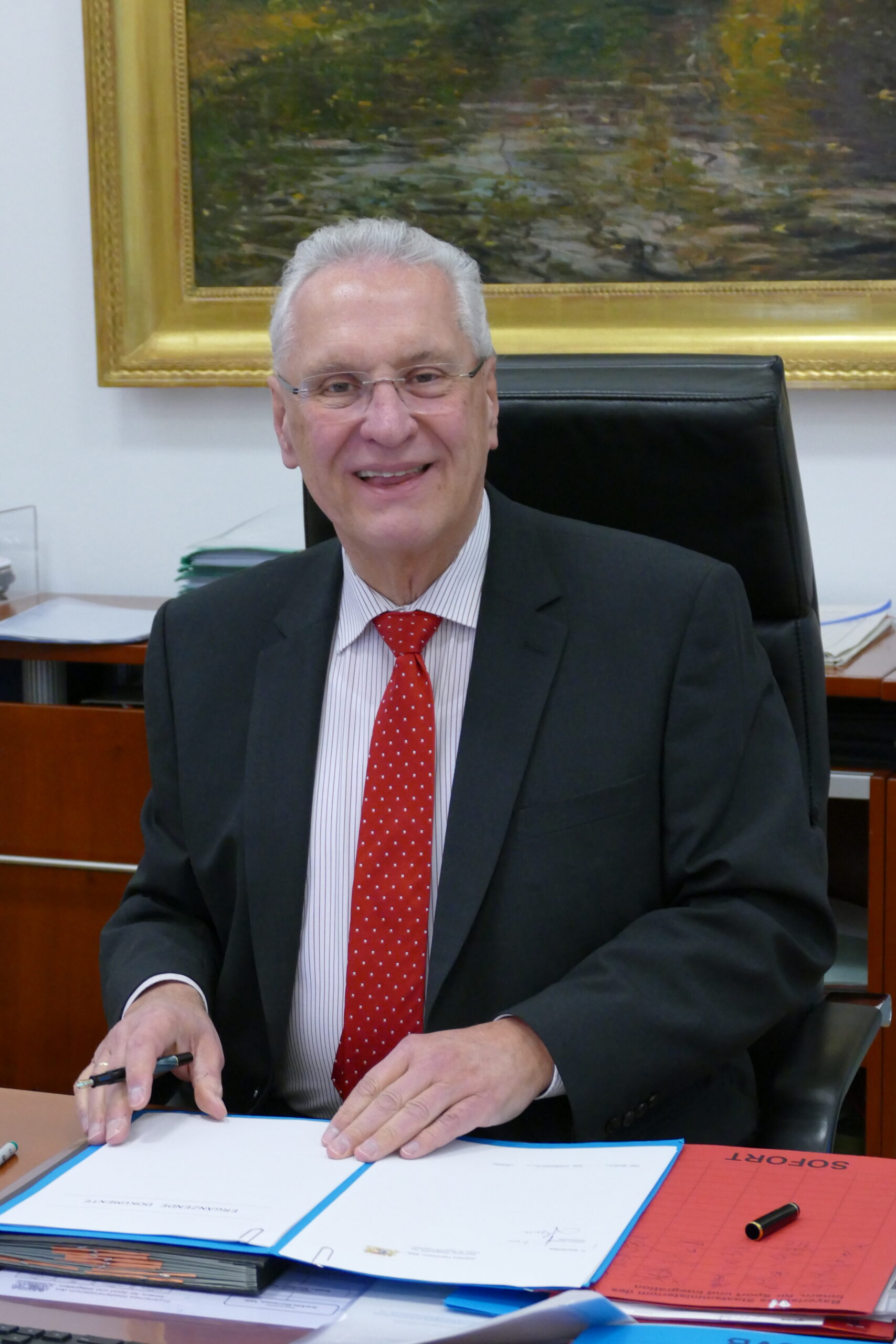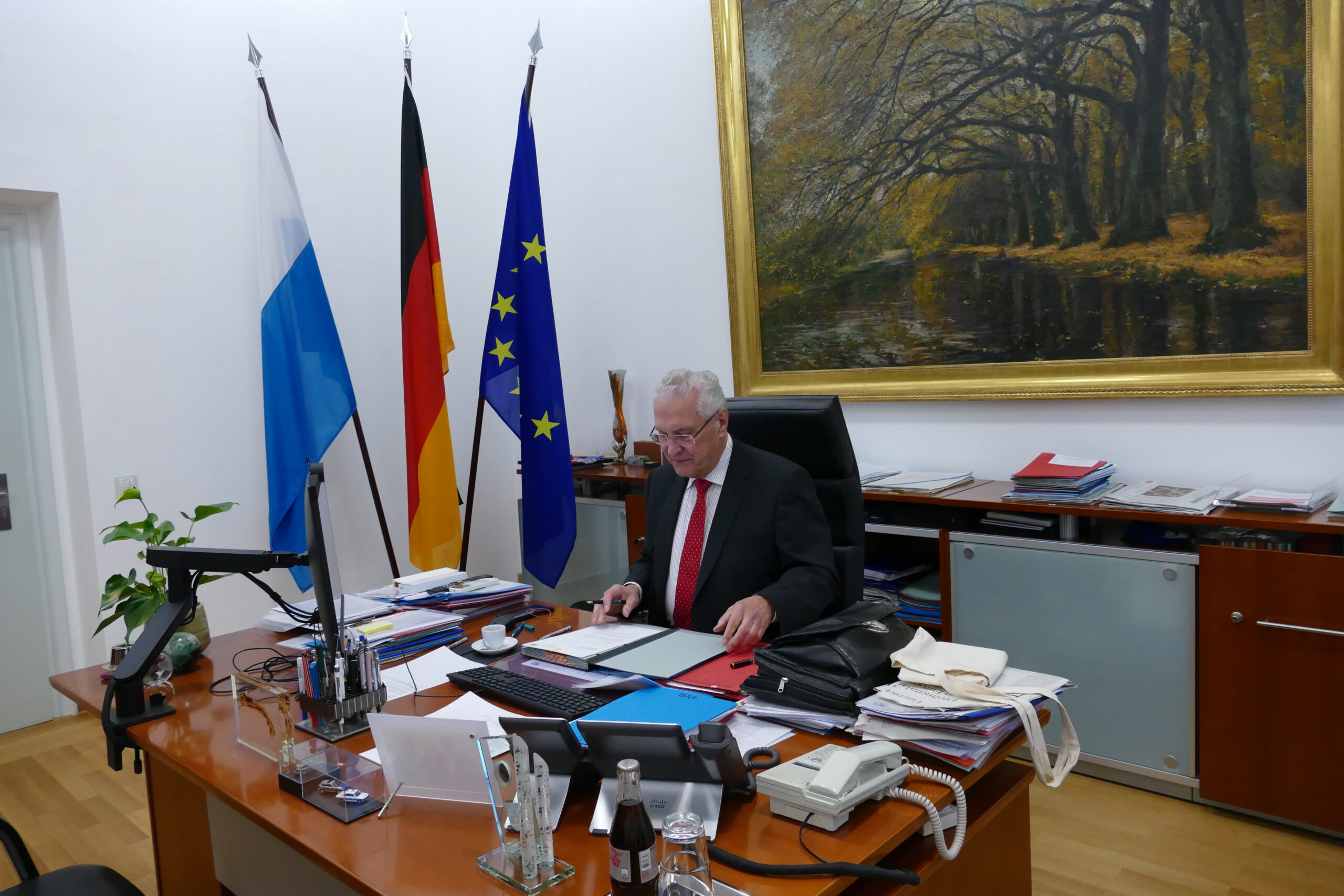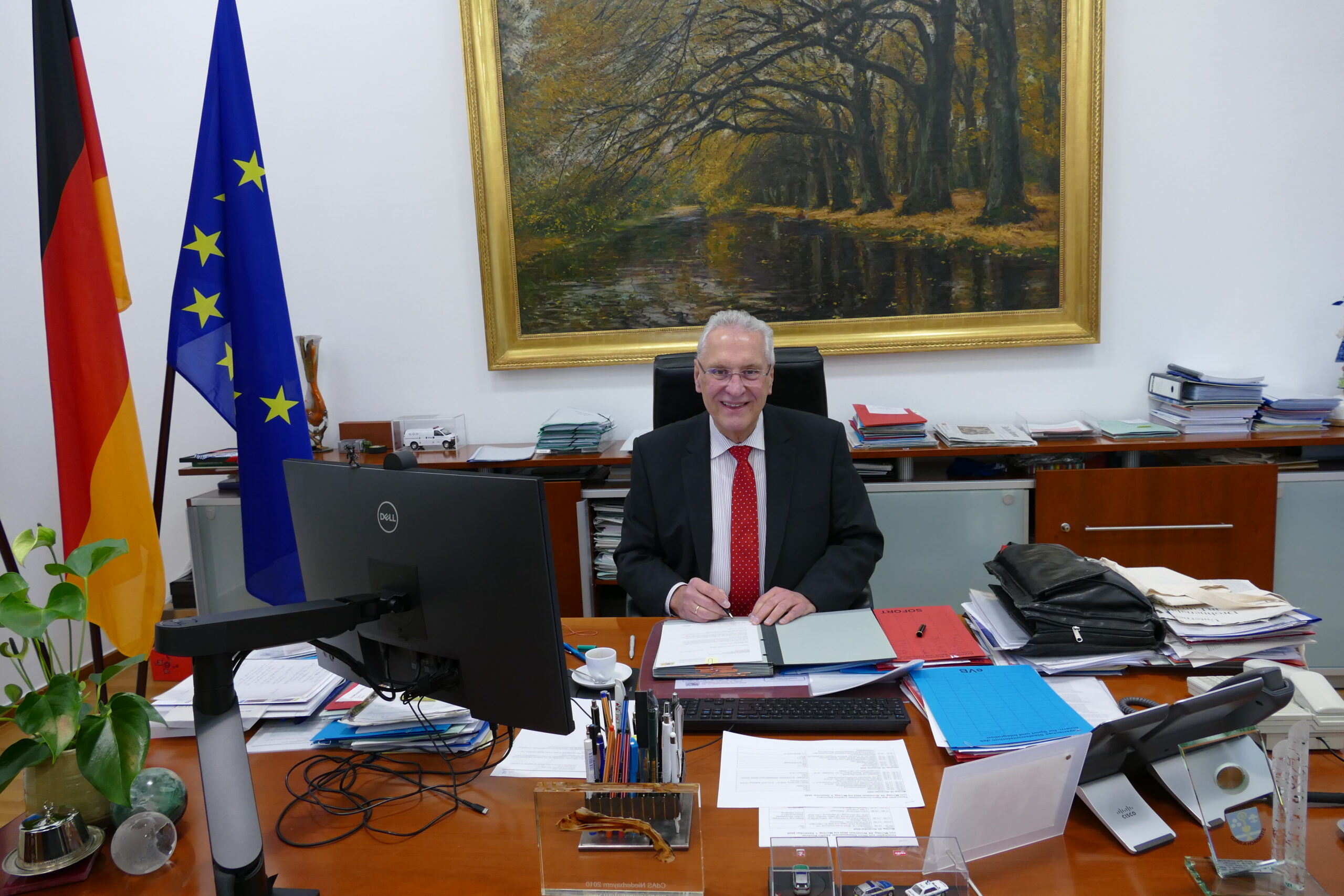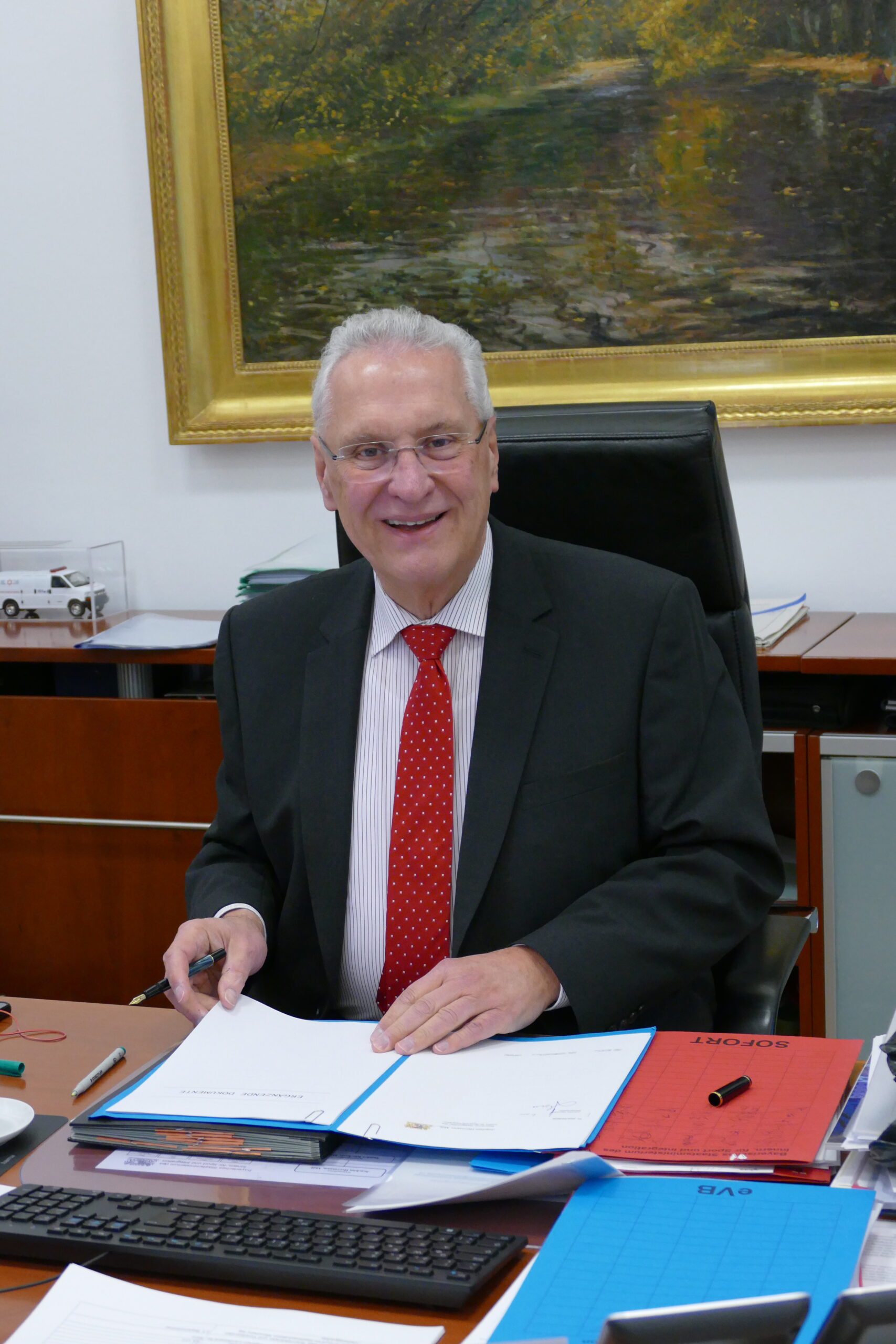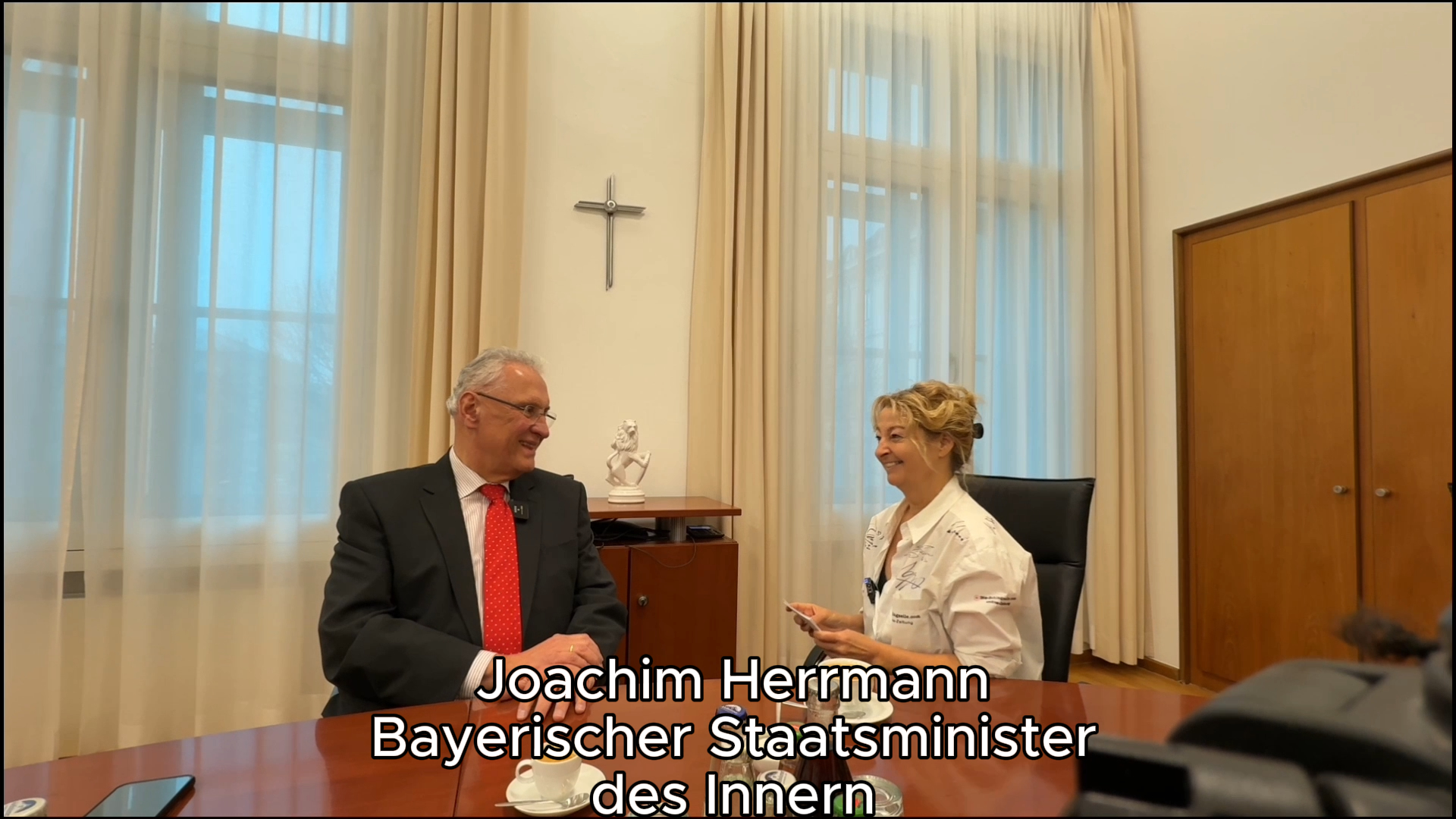
Exclusive Interview
Hello, greetings.
I am very pleased that you have taken the time to do this interview with me today.
My pleasure.
Are you well?
Thank you, I would say, personally, very well, otherwise we have enough to do.
I’m very happy to hear that, very happy indeed.
Yes, I think that’s generally the case in our society now, because the last four weeks before Christmas
are of course particularly busy and people want to get a lot done before the end of the year, so it’s the same thing every year,
yes.
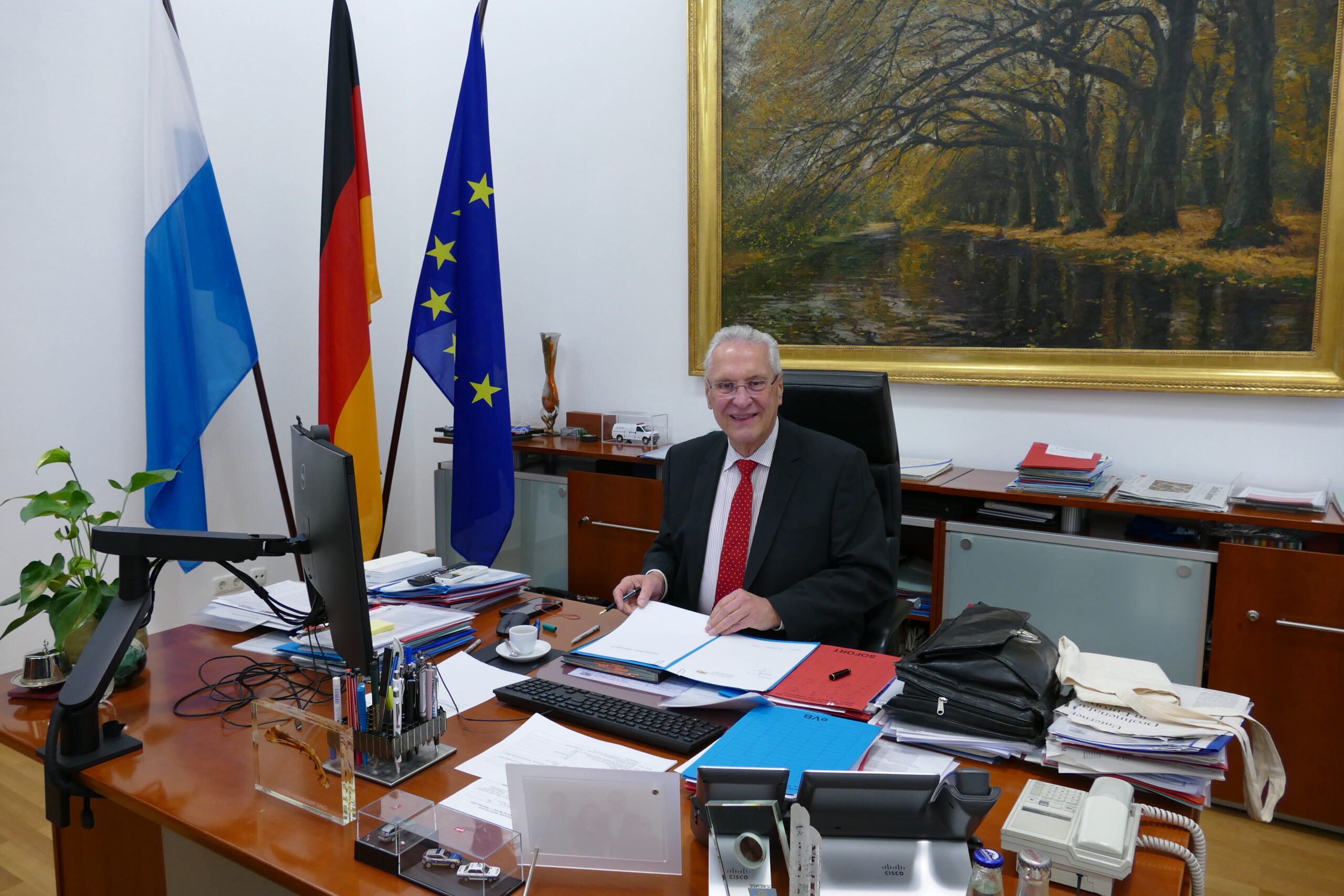
I have been Minister of the Interior here for 18 years.
How did you get here?
I started getting involved in politics in my youth, during my student days, in the Young Union,
then I joined the CSU and was elected to the Erlangen City Council in 1990. In 1994, the state parliament seat
was up for reelection. And then the Erlangen CSU
said with broad consensus that I should do it, and then I was actually elected by the voters
and have been reelected to the state parliament every time since 1994
When Günther Beckstein was elected Minister President in 2007,
he asked me to succeed him as Minister of the Interior. He appointed me to this position, and since then,
the subsequent Minister Presidents,
Horst Seehofer and Markus Söder, have repeatedly appointed me to this office.
So definitely a vocation, with heart and soul?
Yes, well, becoming a minister is appointed by the prime minister; you can’t choose that yourself,
and you can’t formally apply for it, but I can only say that I still do it
with great enthusiasm, and I’m happy even if sometimes
there is, of course, trouble and it represents a certain burden. Overall, I am very happy that I have been able to bear
responsibility for Bavaria for so many
years.
Yes, but ultimately that also applies to each and every one of my employees. It applies to every police officer.
It applies to every firefighter and so on. It always involves a great deal of responsibility, but overall
we fulfill that responsibility very well.
Well, the tasks here at the Ministry of the Interior are varied. There were also years when I was responsible for construction and
transport, and for the last few years I have also been responsible for sport and integration.
It’s hard to explain the full range of tasks I’ve been responsible for over the past 18 years.
One or two things would have been particularly important. I have a particularly painful memory of
a week in 2016 when we had three attacks within eight days: an Islamist attack
on passengers on a local train near Würzburg.
Then there was the rampage by a young man of Iranian descent who had developed a certain xenophobia
and murdered several fellow citizens of Turkish origin in the Olympia shopping center, and two days later
there was another Islamist attack in Ansbach, so in that respect, it was definitely the
most terrible week I have experienced in all my years as Minister of the Interior.
But there have also been many wonderful and very positive experiences, and I am particularly happy and delighted
every week to see the tremendous volunteer work that is being done in our country, and thankfully, I am
constantly confronted with this in a very positive way, especially with the volunteer fire departments and rescue organizations.
It’s good that so many positive things are happening, because otherwise it would be very difficult to cope with.
Yes, we still have a lot of people who are willing to volunteer, and we must be grateful for that
and continue to support and nurture it.
The motivation certainly does not come primarily from me; it comes from men and women who, for example,
have often been in the volunteer fire department for years or have been encouraged to join by friends. Many are also
second or third generation, because their father and grandfather were in the fire department, so there are a wide
variety of backgrounds and a wide variety of motivations.
But my job is, of course, to constantly express my gratitude for this commitment in many places in Bavaria. To the volunteer
firefighters as well as to the rescue organizations or those who are active in the THW, to say a really heartfelt
thank you everywhere.
We also have a lot of volunteer work in sports clubs, and it is really part of my job to say thank you very often on many
occasions for this wonderful commitment.
Actually, very rarely. Over the years, this has happened in situations where I have entered a certain space or met a
certain audience for the first time and didn’t really know what to expect.
This happens extremely rarely, and in most cases I am actually very relaxed in such situations. Even though I sometimes
don’t know what kind of questions to expect in a discussion event, Even if I’m participating in a discussion event,
I sometimes don’t know what kind of questions I can expect and so on.
Most of these conversations tend to be very constructive. It’s actually quite rare for someone to be
really malicious, and as long as everyone asks reasonable questions, gives answers,
and listens to each other, everything is fine.
What does a typical day look like for you?
In some respects, it varies quite a bit. If I don’t have to get up early, I usually get up between
6:45 and 7:00 a.m., have breakfast, read the newspaper, watch TV for a short while in the morning, and then I’m usually
at the office by 8:00 a.m. That could be here in Munich at the ministry. It can be at my representative’s office in Erlangen,
but my working day starts at 8:00 a.m. at the latest. And then it varies greatly.
There may be meetings in one place.
There may be appointments that take me all over Bavaria. And sometimes we drive 1,000 km criss-crossing Bavaria in
a single day, depending on the appointments.
Yes, they really are out on the roads a lot.
Yes, in total, my drivers usually drive over 100,000 km per year. So, of course, that’s a lot.
That also includes trips to interior minister conferences in other federal states or to meetings
in Berlin, and so on. Yes, that’s part of it, and then of course we have the cabinet meetings here in Munich.
We have the state parliament meetings, which of course also require our presence from time to time.
Well, thankfully there are quite a few, because there are many occasions where you meet other people,
where you meet acquaintances and friends again.
Of course, there are special events, like the Erlangen Bergkirchweih, which I’ve enjoyed since my youth,
and that’s a very special and important date every year, around Pentecost. But there are also thousands of
other occasions that I really look forward to.
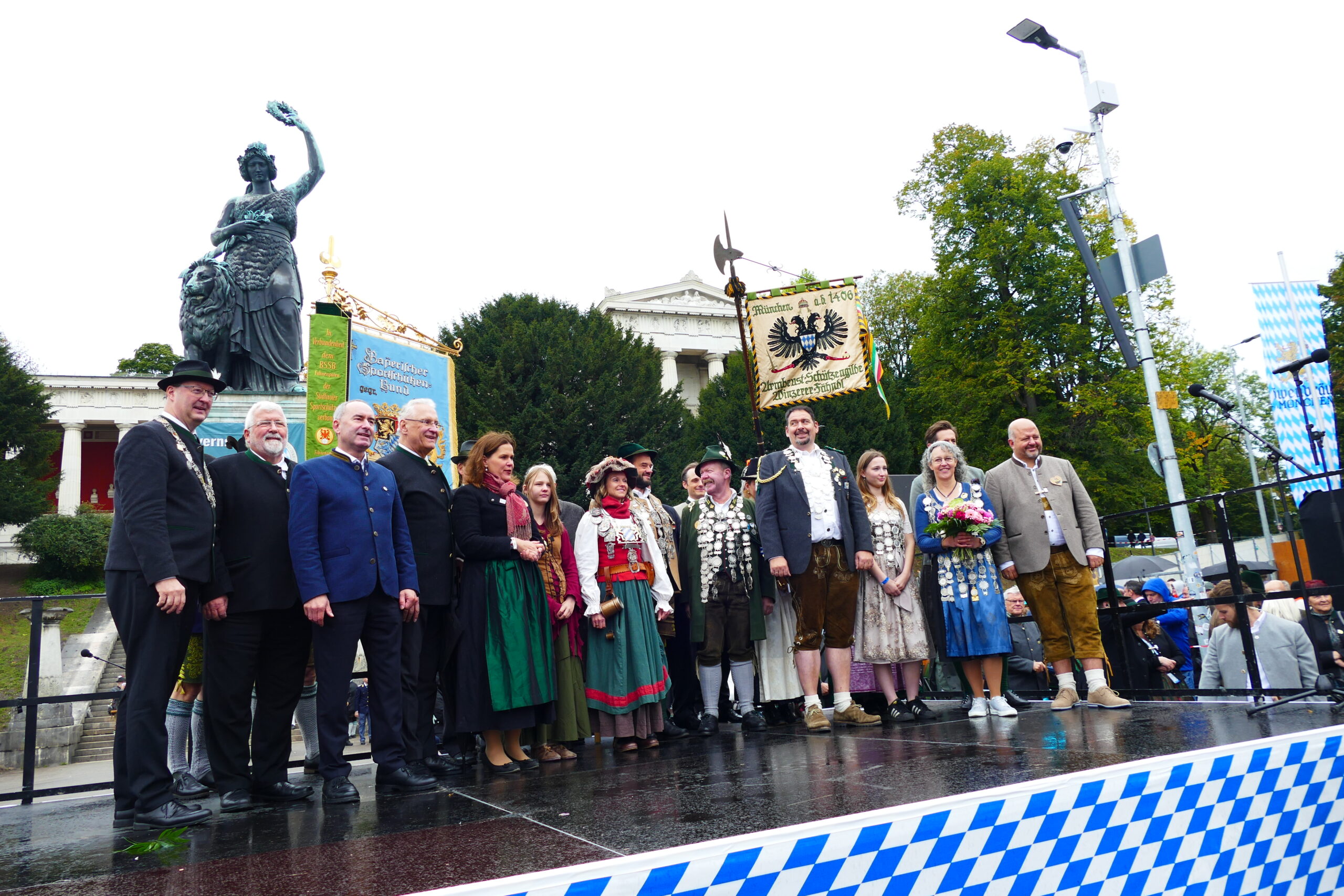
Yes, for example, you were also at the Ab-Böllern auf der Wiesn.
Yes, Oktoberfest is of course a great tradition. It’s obviously two sizes bigger than
the Erlangen Bergkirchweih, but it’s also a great experience, and the most important thing, of course, from the perspective
of the Minister of the Interior, is that it goes off as peacefully and non-violently as possible.
Yes. I think that worked out well. I was there for the entire Oktoberfest and worked as a journalist,
and I was really delighted with the whole atmosphere, and everything went very positively. So it was very enjoyable.
It was very enjoyable, and when else do you have the whole world as your guest?
That’s how it is at Oktoberfest. Guests really do come from almost every part of the world.
The focus of the work of the Minister of the Interior is, of course, always the safety of the people,
which in itself covers a broad spectrum, because it involves conventional crime such as burglaries,
shoplifting, and much more. It also covers terrorist attacks and similar incidents, but security also means having good
fire departments so that help arrives quickly when there is a fire somewhere, or emergency services on the streets
or even precautions in case of disasters, such as major floods or even a train accident, and luckily
in all these situations we can rely on thousands upon thousands of
helpers from the fire departments and rescue organizations, and I am really very, very grateful for that.
Yes, of course, the biggest headlines are naturally made by particularly serious accidents, where there may be several
fatalities or whatever. That naturally preoccupies people in the discussion, and we must of course
always present ourselves credibly so that we do everything humanly possible to ensure that such an accident does not
happen again soon.
Yes, so I was also thinking about natural disasters, where you can only prepare as best you can
and practice for an emergency.
That’s right, we’re now doing a lot of disaster control exercises again. I’m grateful that many cities and counties
in Bavaria are picking up on this. It all fell by the wayside a bit during the coronavirus pandemic, but now we have to practice
everywhere again so that, in the event of an emergency, everyone involved knows each other and knows what the
various individual organizations are particularly good at and what they are less good at, and so on. So we are well positioned
in this regard, and we need to communicate that accordingly.
In any case, I have great respect for all the people who, as I said, sacrifice their free time and are also available for such drills.
That’s right. I have to make sure that I visit all the different sports at various events.
We have a wide range of sports in Bavaria, with a great variety of different disciplines. It’s not just soccer,
which is of course very important with FC Bayern and the other professional clubs.
But we also have thousands of other sports, so I try to accept invitations whenever I can.
I get ten times more invitations than I can accept, but I always try to visit the other sports and find out what’s going
on there, whether it’s rowers or canoeists. Or it might be swimmers.
There are all kinds of different sports, including private individuals who play golf or whatever.
I try to keep track of everything that’s going on in the country, and of course that also applies to the club I’m particularly
involved with, Handball Club Erlangen. They usually play in Nuremberg and have simply
undergone extremely positive development since their founding.
I prefer to get around by bike. I’ve been doing this since I was young and, as I said,
I really enjoy cycling.
I also have a bike here in Munich, which I sometimes use, admittedly only when the weather is nice, to ride from the
Ministry of the Interior to the State Chancellery. There’s no mode of transportation that’s faster than a bike
when I ride through the Hofgarten.
Yes, I spend my free time with my family, but I think that overall it’s very little, because it’s normal for
me to be out and about on appointments on most Saturdays and Sundays throughout the year.
Maybe not every Saturday and Sunday around the clock, but still a lot. In that respect,
the family has naturally been somewhat neglected in recent years and decades. But thank God,
our three children have turned out well, each in their own way, but all wonderfully, and I’m happy when we all get together
again at Christmas.
Christmas, wonderful, that’s great. It’s always the ultimate family event, and I think that’s where the family belongs together.
Absolutely. That’s important.
Yes, yes, we already have three grandchildren, and they will definitely be joining us for Christmas.
Yes, oh, that’s nice.
Well, Munich already hosted the Summer Olympics in 1972.
And we are having a discussion throughout Germany that, after all these years, it should now be Germany’s turn again.
After all these years, it should now be Germany’s turn again. Now we have several cities that have, so to speak,
thrown their hats into the ring. North Rhine-Westphalia would like to have it. The city of Hamburg would like to have it
in the city. Berlin would like to have it, but we have now made it clear. We in Munich would also like to do it.
We believe we can do it. We have good sports facilities, and I was very pleased that the referendum here in Munich
was absolutely positive, with almost two-thirds of all eligible voters in Munich declaring
“Yes, they are in favor of continuing to push ahead with the planning for the Olympic Games here in Munich and
the surrounding area.”
Yes, yes, that’s great. I was personally very happy about it too. It’s really wonderful.
Hi, yes, I think I really like that. The Olympic idea, but you can also say in general
that it sends an important message to our entire society.
That it has once again succeeded in bringing people to the ballot box with positive emotions. Getting people to
speak out in favor of the Olympic Games. We have many opinion-forming campaigns in our country
that are negatively framed, that are primarily opposed to something, that in some cases
simply reject other people across the board, and so on and so forth. I think it’s a very strong sign
that we have now mobilized a positive majority. A majority in the German Bundestag,
which is responsible for hosting the Olympic Games.
We will definitely continue to fight for this.
I am confident that this will work out well. We also have broad public support here in Munich,
and yes, we are benefiting a little from the experience gained in 1972. A lot has changed since then, but I am
sure that we can make it work. If we are ultimately awarded the bid, we have more than
any other candidate city: sports facilities that are ready to use as they are and require only
minimal refurbishment or renovation. In any case, this is an ecological advantage over
other locations that are under consideration.
You have to see. First of all, a decision will be made within Germany next year between
these regions, North Rhine-Westphalia, Hamburg, Berlin, and Munich, which will then be officially sent into the
international race.
That will only be the case in about a year’s time, and the international committee will probably only then
gradually deal with the various cities that have applied. Or the ones that are proposed, take a closer look at them
and say: What don’t we like there, what don’t we like there? In this respect,
I don’t think it’s possible to predict what the decision will be, because the IOC definitely wants to
award the Games for 2036 first, and given the current situation, it’s impossible to say when they will be awarded for 2040 and 2044.
Here in Munich, we have our own department that handles international contacts. Of course, these are also
the colleagues who usually prepare such trips. This applies to visitors
from abroad here with me. There are also my visits elsewhere, and just last month, for example,
I had a meeting with the Ukrainian Consul General. We had talks with the Croatian Minister of the Interior and with
the Czech Minister of the Interior and with the EU Commissioner for Security and Migration, so it’s quite a broad spectrum.
I could give many more examples. Yes, it’s important, my staff organize it and prepare it.
It is usually combined with lunch or dinner, as courtesy dictates, but not
always. Sometimes they are there and it is too rushed.
But these international contacts, especially those within Europe, are very important to me, because ultimately our lives
and also the security in our country are significantly influenced by
how other European countries are doing.
That’s how it is. Every nation has its own identity and traditions, which must be mutually respected and then
discussed.
Where do we have common interests? What do we want to promote together within the European Union?
Or where might there be differences, or where do we need to pay particular attention in terms of economic development?
These are all topics we discuss when we meet.
Yes, well, the most important thing from the perspective of a Minister of the Interior is always to guarantee
and ensure security in our country for as many people as possible, and that will of course continue to be our concern
in the new year, to ensure that everything runs as safely as possible.
No one can promise 100% security, No one can promise 100% security;
there will always be bad people in this world, but we can show, based on statistics from the Federal Criminal Police Office,
that we are by far the safest of all German states, and the Bavarian police will of course
continue to work on this. At the same time, however, we also have the safety of other organizations in mind, such as
the fire department, the emergency medical services, and the rescue services. Sometimes it’s a matter of seconds
how quickly the emergency services arrive. For example, if someone has suffered a heart attack or something similar.
Overall, we can also say that we are well positioned and well equipped in this area.
But we also have to constantly check what new developments there are, including in medical technology on the
market, and so on. And what do we have to do when people dial 112, for example, to ensure that they receive the
best possible care?
I want people to see that this democracy, this republic, thrives on cooperation, and that applies
not only to the job that each individual does, but also to the fact that we must stand by our democracy.
We have an active Office for the Protection of the Constitution, but in the long run, our democracy will not only
exist because the Office for the Protection of the Constitution protects it, but it will only have a future if the people in our
country enthusiastically stand up for this democracy, enthusiastically stand up for freedom and the rule of law. This
seems particularly important to me, especially at the present time, when some political opponents and alternatives
are on the move.
This is our issue, and we must also win people over to participate in it.
Yes, absolutely, because we sense that there are people who actually want to undermine our democracy.
They want to destroy this country, and we cannot stand idly by and watch this happen; we have to take a stand.
True, we will certainly not be able to reduce them to zero, but conversely, it is also important that we make it clear
that the vast majority in our country stands for democracy, stands for a free republic, and we will continue to advocate for this
in the future.
Thank you very much for visiting. Thank you very much for making this possible now that we have been talking about it for a while.
Thank you very much for making this possible now that we have been talking about it for a while.
With pleasure.
You’re welcome.
I wish you all the best for the future.
Thank you, I wish you the same.
You’re welcome.
Thank you very much.
Thank you.
All images, interviews, texts, and videos are copyrighted by Susanne Panhans.